Sanctions Dashboard
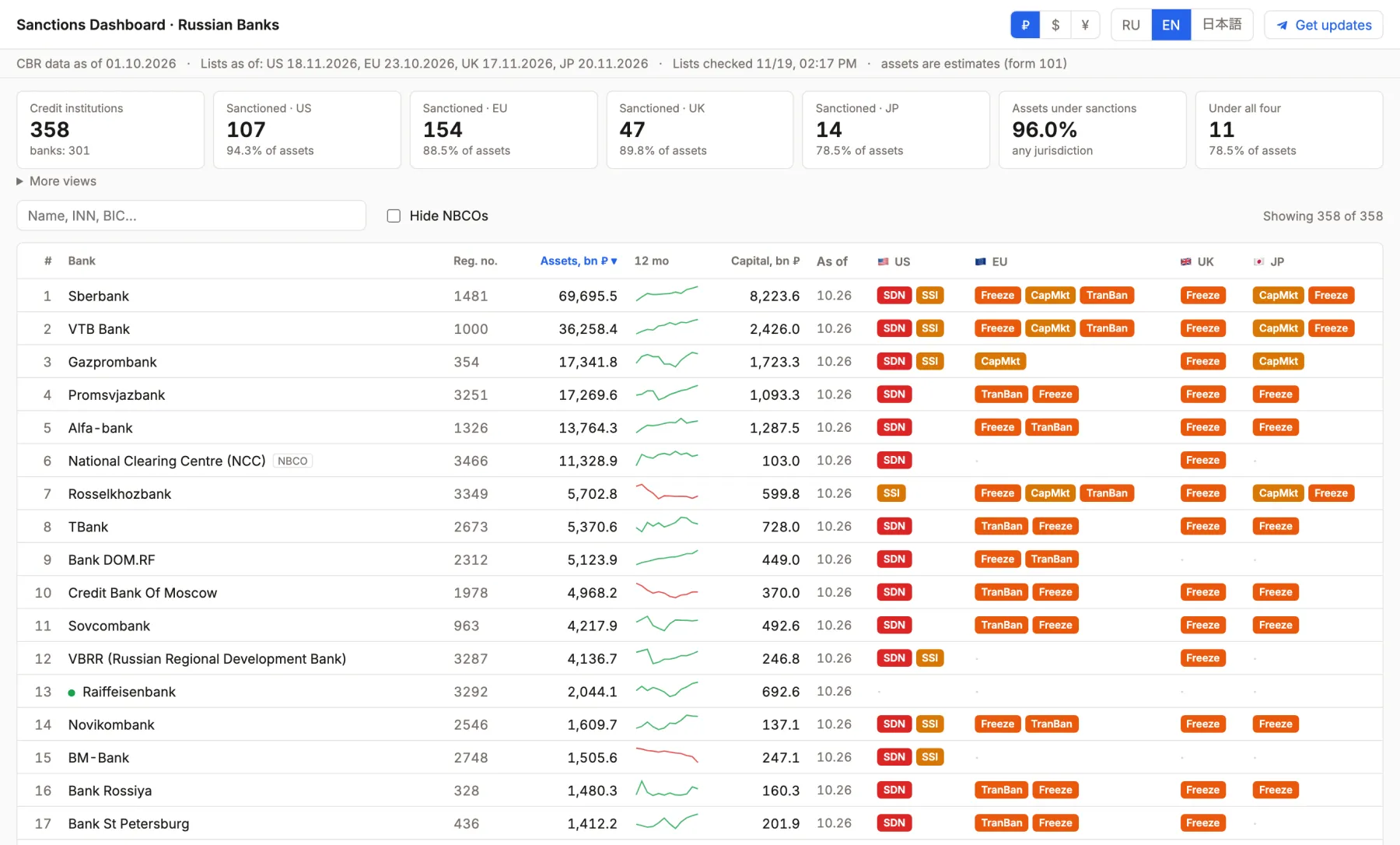
All Russian banks and four sanctions lists — those of the US, the EU, the UK and Japan — in one table: who is under restrictions, exactly which ones, and what share of the sector's assets that is.
- 358credit institutions from the Bank of Russia register
- 4jurisdictions: the US, the EU, the UK and Japan
- 96 %of the sector's assets are under the sanctions of at least one of them
- 10 minthe interval at which the regulators are polled
One bank, four lists, four formats
Sanctions lists are maintained by different agencies, each in its own format. Banks are named differently in them: in Latin script, in outdated spellings, without an INN. To answer a simple question — which sanctions is this bank under? — you have to reconcile four sources with the Bank of Russia register.
The dashboard does this reconciliation itself and keeps the result in one table: a bank's status in every jurisdiction, the type of restrictions, assets and capital, and the share of the sector under sanctions. It also notices on its own when a regulator has changed something.
One table and everything behind it
The interface is in Russian, English and Japanese; amounts are in rubles, dollars or yen.
01Bank table
Every credit institution in the country, with assets and capital from Bank of Russia reporting and the change in assets over twelve months.
02Status by jurisdiction
Not just “sanctioned” but the type of restrictions: blocking, sectoral, a ban on transactions, capital market restrictions.
03Summary figures
How many institutions are sanctioned in each jurisdiction, what share of the sector's assets that is, and how many banks are under all four.
04Bank profile
The list entries the status is based on, with a link to the bank's page in the register — so that the conclusion can be verified.
Primary sources only
The lists are taken from the regulators themselves, the information on banks from the Bank of Russia. There are no intermediaries and no purchased databases: every status has an entry in an official list, and the date of each list is shown in the line above the table.
Sanctions lists
- The US: OFACthe SDN list and sectoral sanctions lists
- The EU: the consolidated financial sanctions file and acts in EUR-Lexasset freeze, ban on transactions, capital markets
- The UK: the UK Sanctions Listasset freeze
- Japan: the Ministry of Financeasset freeze and securities restrictions
Banks
- The Bank of Russia register of credit institutionsnames, licenses, INN and OGRN
- Form 101assets, monthly
- Form 123capital
- Bank of Russia exchange ratesconversion into dollars and yen
A mistake in either direction is costly
A false “sanctioned” and a missed bank are equally bad, so anything doubtful is decided by a human, and a broken source cannot change the picture by itself.
Polling
Every ten minutes the regulators' signals are checked. If something has changed, a full cycle is started.
Matching
List entries are matched to the register: first by INN and OGRN with a checksum, then by name.
Anything disputable goes to a human
Doubtful matches go to the moderator via a bot: “same bank” or “false match”.
Comparison with the previous snapshot
The new snapshot is compared with the previous one: what was added, what was lifted, what was tightened.
Publication
The dashboard is updated, and a draft message is prepared for the channel — a human publishes it.
- A name is not proof
- The Avangard plant is not Avangard bank. A name match is accepted only together with evidence that the entity is a credit institution, and everything borderline waits for the moderator's decision and is remembered: a similarity that has been rejected once never comes up again.
- A broken source
- If a list returns noticeably fewer entries than last time, that looks more like a failure than a mass lifting of sanctions. The dashboard stays on the previous snapshot until a human confirms that the reduction is real.
- An outside check
- A separate check on the server reconciles the dashboard with EU publications on its own. If the regulator has issued an act and the dashboard does not know about it, this becomes visible without a human — a person once found such a case, and this check was added as a result.
- Repair
- When a source changes its format and a parser breaks, an executor agent prepares a fix in a separate branch and a skeptic agent checks it. A human merges and deploys.
- How the code was written
- The code was written in dialogue with Claude Code and, before the move to its own server, was audited by three independent reviewers. The matching rules are pinned down by tests on a reference set of banks.
Changes in the lists — as a message
“Sanctions Monitoring · Russian Banks” is an open channel: anyone can subscribe.
There is no need to keep an eye on the dashboard: when a regulator changes a list, a message arrives. It says which banks are affected, the type of restrictions, and how the share of the sector's assets under that jurisdiction's sanctions has changed.
- New sanctions: which banks have appeared on a list and under what restrictions
- Tightenings: a bank on a list has received a new type of restriction
- Removals from the lists
- Every message carries a link to the source and to the dashboard
Every message is reviewed by a human before publication. When there are no changes, the channel stays silent.