Russia–Japan Trade
What the two countries sell each other and for how much: by product down to the nine-digit code, by port and by company — with data up to the latest published month.
- 2017monthly data from January of that year
- HS9detail down to the nine-digit product code
- 122Japanese customs offices on the map
- 5 600+Russian companies from open registers
The statistics exist, but there is no one to read them
Russia has not published customs statistics since 2022, and the international databases come out a year or two late and only down to six-digit codes. Meanwhile Japan Customs posts trade with Russia every month by nine-digit code and by customs office — but as scattered tables.
The dashboard brings them together in one place. You can see what exactly moves in each direction, in what volumes and through which ports, how it has changed and which companies — Russian and Japanese — stand behind the flows of goods.
Six pages
The interface and the product names are in Russian, English and Japanese.
01Trade
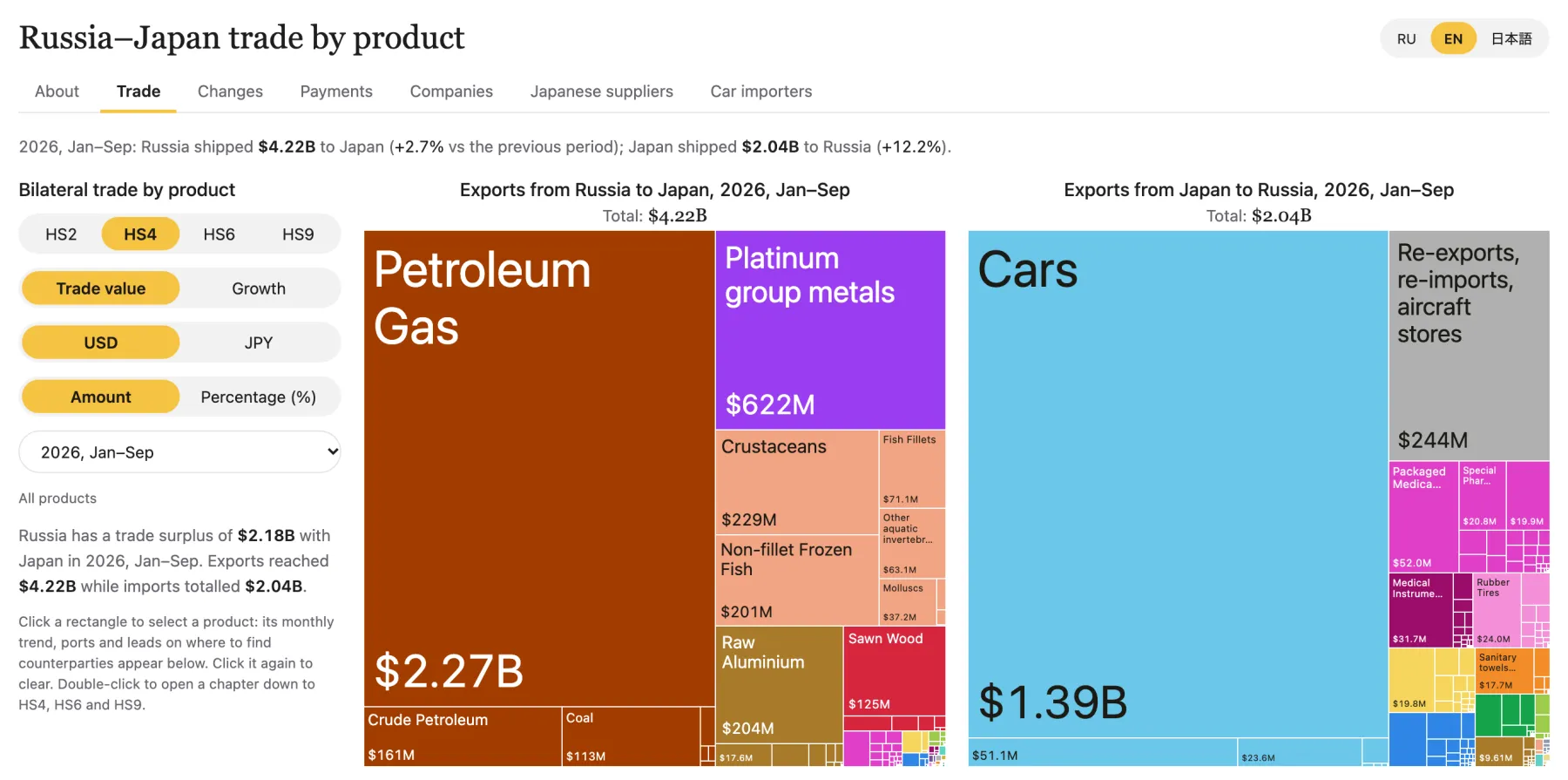
The structure of trade in the selected period: two treemaps, the monthly trend, a product card and a map of Japanese customs offices.
02Changes
Compares any two periods: which product groups are growing and which are falling — at any level of detail.
03Payments
Money flows beyond goods: services, travel, investment income, direct investment and invoicing currencies.
04Companies
Russian exporters to Japan and importers of Japanese goods, matched to product categories, with a level from A to C.
05Japanese suppliers
Japanese companies whose products reach Russia: groups and legal entities, their Russian counterparties and the supply channel.
06Car importers
Companies and sole proprietors in the Far East and Siberia trading in vehicles and parts — with a map and the year they started.
Primary sources only
Both directions of trade are taken from Japanese statistics: Japan's imports from Russia are Russia's exports, and vice versa. Company information comes from open government registers, with no purchased databases.
Japan and the exchange rate
- Japan Customs, the e-Stat portalgoods by country and by customs office, monthly
- Ministry of Finance of Japanbalance of payments and direct investment by country
- Ministry of Agriculture, Forestry and Fisheries of Japanforeign plants holding JAS certificates
- Japan's register of corporate numbersofficial names of the suppliers
- US Federal Reservethe average monthly yen–dollar rate
Russia and the EAEU
- Federal Tax Servicethe Unified State Register of Legal Entities, the register of small and medium-sized businesses, financial statements
- Rosselkhoznadzor, the Cerberus systemplants certified for export to Japan
- RusAccreditationdeclarations and certificates for Japanese products
- Roszdravnadzor and the Ministry of Healthmedical devices and medicines made in Japan
- The EAEU unified register of certificates and the Federal Customs Servicestate registration of products; customs representatives
A pipeline that knows how to stop
The main thing in it is not the collection but the third step: doubtful data never reaches the site.
Collection
Scheduled scripts fetch the new months and the latest register extracts.
Build
Yen are converted into dollars, codes get their names, and companies are matched to products.
Checks
The new data is compared with the previous version. If it does not add up, nothing is published.
Publication
The page is rebuilt from scratch, and a report on the changes is written for each release.
Message
The bot tells the Telegram channel what is new. When there is nothing to say, it stays silent.
- Schedule
- The Japanese sources are checked twice a day, the Russian registers once a week. Japan Customs publishes each month about four weeks after it ends; the dashboard picks up the release the same day.
- What stops publication
- An incomplete release, a missing month, a truncated file, or a total for a past month that has changed by more than 10%. The site stays as it was, and the owner gets a message with the reason.
- Calendar watchdog
- If the customs calendar says a release was due today but no new data has arrived, a message is sent about that too: a silent source must not look like “nothing new”.
- How the code was written
- All the code was written in dialogue with Claude Code. The human sets the tasks, makes the decisions and accepts the work; the model writes the code, the tests and the documentation. Decisions and their reasons are kept in the project log, and from time to time a separate “skeptic” reads the whole project and draws up a prioritized list of remarks.
The dashboard reports what is new on its own
The Telegram channel is private: the owner approves each request to join.
The dashboard is not static. The data is updated on a schedule, and every time something new comes out the bot posts about it in the channel — there is no need to visit the site and check for yourself.
- Preliminary monthly totals — on the day Japan Customs publishes them
- Full data: the highlights in both directions and what to look out for
- Revisions of past years and new periods on the Payments page
- A weekly summary of new companies

Торговля Россия — Япония: предварительные данные за октябрь 2026
- Экспорт России в Японию — 922 億円 (≈ $583 млн): +23,1% к октябрю 2025 г., +8% к сентябрю, максимум с декабря 2023 г. Главный вклад в рост — СПГ (+37%).
- Экспорт Японии в Россию — 355 億円 (≈ $225 млн): −0,8% г/г, +15% к сентябрю. Главный вклад в снижение — лекарства (−69%).